



Back pain between the shoulder bladesit occurs with pathologies of the spine (postural disorders, osteochondrosis, ankylosing spondylitis), diseases of the esophagus (gastroesophageal reflux disease, achalasia cardia, strictures), mediastinitis.Less often, the symptom develops against the background of aortitis, aortic dissection or malignant mediastinal tumors.The diagnostic complex includes radiography of the spine, OGK, CT and MRI, endoscopy.The condition of the blood vessels is evaluated using ultrasound and aortography.The pain is relieved by the prescription of NSAIDs or narcotic pain relievers.The treatment of the underlying disease consists of pharmaceutical, physiotherapy and surgical methods.
Causes of back pain between the shoulder blades
Respiratory diseases
Pain between the shoulder blades occurs in acute tracheitis or bronchitis, when discomfort radiates from the chest to the back.At rest, the discomfort in the back is insignificant, but it increases strongly when coughing, laughing or speaking loudly.The pain is dull in nature;burning and rawness in the interscapular area are less common.The symptoms last for 3-7 days and disappear without a trace after the inflammatory process ceases.
Postural disorders
The causes of pain between the shoulder blades are often scoliosis, kyphosis or lordosis.The symptoms develop after sitting in an uncomfortable position for a long time, sleeping on a too soft or, on the contrary, very hard mattress.Dull or aching pain occurs, which intensifies when bending or making a sharp turn.Unpleasant feelings can already be observed at a young age, which is related to the spread of postural disorders in children.
Similar symptoms are observed in patients with a special juvenile pathology - Scheuermann-Mau disease.In such cases, thoracic kyphosis is intensified, which manifests itself in severe back pain and long-lasting discomfort in one position.As the disease progresses, adolescents feel a sharp pain between the shoulder blades, which occurs in the evening.
Thoracic osteochondrosis
Patients with degenerative spinal disease suffer from dull back pain between the shoulder blades caused by constant muscle tension and compression of nerve structures.The discomfort becomes stronger when the body is turned and bent, standing or sitting for a long time.In case of severe pain, a person's daily physical activity is limited.
Severe interscapular pain is observed in herniated thoracic spine.If the upper parts of the chest are affected, the clinical picture is complemented by numbness and tingling of the hands, as well as difficulty in swallowing.The pathology of the middle thoracic region is characterized by intercostal neuralgia, and if the lower thoracic vertebrae are damaged, sharp pain is felt in the epigastrium and under the ribs.
Ankylosing spondylitis
The early symptoms of the disease are primarily discomfort in the lumbar spine, but as ankylosing spondylitis progresses, the symptoms spread to the back, between the shoulder blades.Unpleasant sensations develop in the evening or at night, intensify in the morning, and decrease or disappear completely during the day.The pain is reduced after a warm shower or bath or physical activity.
The spread of the pathological process to the thoracic spine is accompanied by increased kyphosis and tonic tension of the spinal muscles.Therefore, pain in the interscapular region becomes constant and reduces the patient's motor activity.Over time, a characteristic hump forms on the back.A typical symptom of ankylosing spondylitis is sacroiliitis, inflammation of the sacroiliac joint.
Diseases of the esophagus
Most esophageal pathologies are characterized by pain radiating to the interscapular space.In this case, a clear connection is established between discomfort and food intake, as well as physical activity performed by bending the body forward.The symptoms are complemented by a retrosternal burning sensation, heartburn and sour belching.Back pain between the shoulder blades is most often caused by:
- GERD.In the case of reflux esophagitis, a burning sensation behind the sternum and in the back area is typical 10-20 minutes after finishing a meal.The manifestations intensify when the patient takes a lying position, bends a lot and does physical work.Frequent heartburn and sour belching are observed.
- Achalasia cardia.If the opening of the lower esophageal sphincter is violated, sharp retrosternal and interscapular pain occurs at the moment of swallowing.At first, the symptoms appear sporadically - when eating hastily, chewing poorly and swallowing large pieces at once.Dysphagia then becomes permanent.
- Narrowing of the esophagus.The narrowing of the lumen of the organ is accompanied by difficulties in the passage of the food bolus, which causes sharp pain in the chest, in the space between the shoulder blades.The patient feels that the food is stuck in the middle of the esophagus, and swallowing movements do not help to move it further and only increase the discomfort in the back.
Diaphragm hernia
It is characterized by severe pain that spreads to the upper abdomen and moves to the interscapular area.Often, in the case of a hiatal hernia, pain also occurs in the pre-cardiac region, which is mistaken for an angina attack.Symptoms appear after eating, physical activity and exertion.To reduce discomfort, patients induce vomiting or belching and drink water.
Aortic pathologies
Back pain occurs with aortitis.The discomfort is localized between the shoulder blades, behind the sternum, and sometimes moves to the neck or epigastric region.Less often, a painful burning sensation appears in the chest and radiates to the back.Pain is a constant concern and does not depend on the influence of external factors.Tachycardia, shortness of breath on exertion, at rest and a dry cough are typically observed.
Excruciating retrosternal pain radiating to the interscapular area and extending from top to bottom in dissecting aortic aneurysm.Sometimes the sensations are so strong that the patient loses consciousness from the painful shock.The blood pressure drops, the pulse speeds up, and the brain lacks oxygen.If a person does not receive emergency medical care, the risk of death is high.
Mediastinitis
Sudden onset of intense pain, felt in the area between the shoulder blades, is characteristic of acute posterior mediastinitis.The discomfort increases when swallowing, throwing back the head and coughing.In order to reduce back pain and facilitate breathing, the patient sits with his head tilted forward and slightly bent.Edema and cyanosis develop in the upper half of the body, sometimes subcutaneous emphysema also occurs.
Acute inflammation of the mediastinum is accompanied by severe poisoning, so the pain syndrome is accompanied by febrile fever, weakness and cardiac dysfunction.In chronic mediastinitis, the symptoms are less pronounced: moderate dull pain in the back, behind the sternum, long-lasting low fever, and periodic swallowing disorders.
Mediastinal cancer
The main complaint of patients with malignant tumors of the mediastinum is pain in the retrosternal region, which radiates to the area between the shoulder blades.The symptom appears in the late stages of the disease and is caused by the growth of the tumor into adjacent structures and nerve endings.The unbearable pain syndrome is accompanied by shortness of breath and cough when the bronchi are involved in the process, dysphagia when the esophagus is involved, puffiness and cyanosis of the face when the upper part of the vena cava is compressed.
Rare reasons
- Injuries: vertebral fracture, spondylolisthesis, crack or fracture of the scapula.
- Muscle diseases: myalgia, myositis, muscle tone syndrome.
- Lung diseases: pneumonia, dry or exudative pleurisy.
Diagnostics
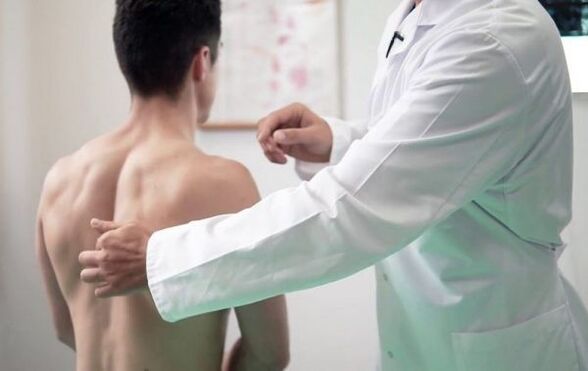
The first examination is carried out by an orthopedic traumatologist who, after a physical examination, detects bad posture, spinal curvature and other musculoskeletal problems.If the pain between the shoulder blades is not associated with bone pathology, the patient is consulted by a cardiologist, neurologist or gastroenterologist.Instrumental tests are prescribed to find out the etiological factors of back pain:
- X-ray of the spine.Based on the results of the X-ray, the doctor determines the degree of scoliosis, the presence and severity of kyphosis or lordosis.The method is informative for the diagnosis of thoracic osteochondrosis and helps to visualize post-traumatic bone changes.To detect an intervertebral hernia, radiography is supplemented with CT or MRI of the spine.
- X-ray of the OGK.The standard research method allows us to exclude lung diseases as one of the causes of pain between the shoulder blades.X-rays also show widening of the mediastinal shadow and signs of subcutaneous emphysema, which entitles the doctor to diagnose mediastinitis.
- EFGDS.To confirm the esophageal etiology of the pain, we perform an endoscopic examination of the esophagus.During the examination, the gastroenterologist pays attention to the patency of the organ, the coherence of the sphincter muscles, and studies the condition of the mucous membrane of the organ.Suspicious areas are biopsied for histological analysis.
- Ultrasound angioscanning.Ultrasound examination of the aorta is used as a screening method to detect inflammatory lesions and aneurysms.Transesophageal echocardiography is performed to assess the condition of the chest region.The diagnosis of a dissecting aneurysm is confirmed by an X-ray method - aortography.
- Laboratory methods.They play a supporting role in the diagnostic search.Patients undergo a standard complex: hemogram, biochemical blood test, test for hepatitis and HIV infection.According to the indications, a coagulogram is performed.In case of a possible acute inflammatory process, the data on the indicators of the acute phase are informative.If ankylosing spondylitis is suspected, the HLA-B27 antigen is determined.
Given the variety of causes of interscapular pain, further investigations may be necessary.In the case of upper respiratory disorders, an otolaryngologist consultation and a complete otolaryngological examination are required.If a malignant tumor of the mediastinum is suspected, oncologists are involved in the diagnosis.

Treatment
Help before diagnosis
Most non-pharmacological measures are aimed at preventing pain between the shoulder blades: establishing and maintaining correct posture, a balanced diet without harmful foods, an active lifestyle and sports.In case of severe pain during the diagnostic search, the doctor prescribes non-narcotic pain relievers, recommends limiting mobility and, if necessary, prescribes strict bed rest.
Conservative therapy
A differentiated approach is used in the treatment of back pain between the shoulder blades - the therapeutic regimen is selected individually, taking into account the leading disease causing the symptoms and concomitant pathologies.In the case of orthopedic problems, posture correction with the help of braces and other orthoses comes to the fore.The following drug groups are used to treat the causes of pain:
- Nonsteroidal anti-inflammatory drugs.It is prescribed to alleviate the discomfort of diseases of the osteoarticular system, as well as to eliminate inflammation and speed up healing.NSAIDs are also effective in diseases of the respiratory organs and mediastinitis.
- Medications that inhibit secretion.Proton pump inhibitors and H2-histamine blockers are the mainstays of treatment for GERD and achalasia cardia.Medicines reduce damage to the esophagus caused by acidic stomach contents and relieve pain.Non-absorbable antacids should be taken to quickly relieve the burning sensation.
- Antibiotics.Massive antimicrobial therapy is indicated for acute forms of mediastinitis in order to destroy pathogens and prevent bacterial complications.Medicines are selected empirically.A combination of 2-3 agents is introduced to affect all possible microbes.
- Cytostatics.Polychemotherapy is chosen for certain forms of mediastinal cancer as preparation for surgery or as palliative care.Immunosuppressants are sometimes recommended to patients with severe forms of ankylosing spondylitis.
Patients suffering from acute conditions (aortic dissection, fulminant mediastinitis) are treated in the intensive care unit.The goal of the treatment is to eliminate the state of shock: for this purpose, cardiotropic drugs, infusion solutions are used, and oxygen support is provided.Narcotic pain relievers and sedatives are administered to relieve pain.
Non-pharmacological methods play an important role in the treatment of musculoskeletal diseases.Special exercise therapy complexes are prescribed to strengthen the ligaments and create a balanced posture.Manual manipulation, kinesiotherapy, orthopedic massage of the chest, back and waist show good results.Many physiotherapy methods are used: electrical stimulation of the back muscles, peloid therapy, general ultraviolet radiation.
Surgical treatment
In case of permanent deformity of the spinal column, surgical correction of scoliosis is recommended.Surgical treatment of osteochondrosis is used in case of spinal compression: the intervertebral hernia is removed and the spinal canal is squeezed out.Minimally invasive techniques are usually used: puncture vaporization of the disc, microdiscectomy.
In the case of complicated forms of diaphragmatic hernia and severe narrowing of the esophagus, surgical interventions are recommended.The hernial opening is sutured with curorrhaphia, gastropexy or fundoplication, resection and esophagoplasty.Emergency surgery is the only method of treatment for a dissecting aneurysm.Vascular surgeons perform resection of the damaged area by reconstructing the aorta.